Free Functional Skills and Skills for Life resources
Site Search
FM Context free underpinning
A resource that focuses on explaining or assessing underpinning skills using no or very little context. (I.e. using only numbers, symbols and/or basic diagrams). This could include worksheets, explanatory handouts or presentations, and reference sheets.
I made this revision resource to support learners in a shorter number lesson. Includes step by step guides to rounding and other skills along with links to useful videos. Covers the following learning objectives:
Level
Level 1
Level 2
Maths
FM Context free underpinning
FM Contextualised underpinning
FM L1.1 Read, write, order & compare large numbers (up to one million)
FM L1.2 Recognise and use positive and negative numbers
FM L1.4 Use multiplication facts and make connections with division facts
FM L1.12 Approximate by rounding to a whole number or to one or two decimal places
FM L1.15 Estimate answers to calculations using fractions and decimals
FM L2.1 Read, write, order & compare positive & negative numbers of any size
FM L2.2 Carry out calculations with numbers up to 1 million inc. strategies to check answers e.g. estimation & approximation
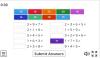
Practise using reordering strategies with these extra E2 (E1 questions are in a separate Wordwall activity) questions for our recently updated E1-E2 Mental addition strategies (reordering) PDF worksheet (Maggie Harnew, 2005, updated Feb 2022). Match the correct answer to each addition problem. (Reordering involves adding up large numbers first and/or looking for pairs of numbers that add up to 10, 20, 30, etc.). Can be used independently of the original resource.
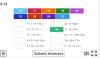
Practise using reordering strategies with these extra E1 (E2 questions are in a separate Wordwall activity) questions for our recently updated E1-E2 Mental addition strategies (reordering) PDF worksheet (Maggie Harnew, 2005, updated Feb 2022). Match the correct answer to each addition problem. (Reordering involves adding up large numbers first and/or looking for pairs of numbers that add up to ten. Can be used independently of the original resource.
Level
Entry Level 1
Maths
FM Context free underpinning
FM E1.3 Add numbers which total up to 20, & subtract numbers from numbers up to 20
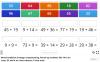
Practise using compensation strategies with these extra questions for our recently updated E2 Mental addition strategies (compensation) PDF worksheet (Maggie Harnew, 2005, updated Feb 2022). Match the correct answer to each addition problem.
These two PowerPoints cover the properties of 2D and 3D shapes (E2-E3) - faces, edges, vertices and line symmetry. This is assessed using a quiz in PPT1. Both PPTs then move on to recognising nets and drawing nets of cubes and cuboids (now found in Level 1 exams). The second PPT can be printed off and used as a workbook. I have also included two links to You tube but you can use your own favourite shape/nets video links if you prefer.
Editor's note
Level
Entry Level 2
Entry Level 3
Level 1
Maths
FM Context free underpinning
FM E2.19 Recognise & name 2-D & 3-D shapes including pentagons, hexagons, cylinders, cuboids, pyramids, spheres
FM E2.20 Describe properties of common 2-D & 3-D shapes including nos. of sides, corners, edges, faces, angles & base
FM E3.19 Sort 2-D & 3-D shapes using properties including lines of symmetry, length, right angles, angles inc. in rectangles & triangles
FM L1.24 Draw 2-D shapes & demonstrate an understanding of line symmetry & knowledge of the relative size of angles
FM L1.25 Interpret plans, elevations & nets of simple 3-D shapes
I designed this resource to help learners at Entry Level 3 Functional Maths understand the importance of setting out and working out multiplication calculations. I've also included some stretch questions.
Editor's note
Level
Entry Level 3
Maths
FM Context free underpinning
FM Simple one step problem(s)
FM E2.6 Times tables 0x0 to 12x12
FM E3.4 Multiply 2-digit numbers by 1- & 2-digit numbers
I've just designed this ready for my new starts in September. It is surprising how many learners come that get basic things wrong.
As we know FS is all about reading the questions and showing workings out. I always do 5 weeks of no calculators as for some they just do not get the borrowing / carrying over and this is of course important on the non calculator papers now.
There is also an E2-E3 version of this resource.
Editor's note
Level
Entry Level 3
Level 1
Maths
FM Context free underpinning
FM Simple one step problem(s)
FM E3.2 Add & subtract 3-digit whole numbers
FM E3.10 Calculate with money using decimal notation & express money correctly in writing in pounds and pence
FM L1.2 Recognise and use positive and negative numbers
FM L1.11 Add, subtract, multiply & divide decimals up to 2 decimal places
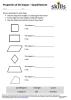
Name each 2D shape and describe its properties. Two separate worksheets: one for triangles, one for quadrilaterals. For Entry Level, hence angles are not a focus.
For each of the 6 quadrilaterals and 4 triangles, the learner is prompted to answer these questions:
Level
Entry Level 2
Entry Level 3
Maths
FM Context free underpinning
FM E2.19 Recognise & name 2-D & 3-D shapes including pentagons, hexagons, cylinders, cuboids, pyramids, spheres
FM E2.20 Describe properties of common 2-D & 3-D shapes including nos. of sides, corners, edges, faces, angles & base
FM E3.19 Sort 2-D & 3-D shapes using properties including lines of symmetry, length, right angles, angles inc. in rectangles & triangles
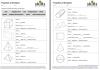
Name each 3D object and fill in the gaps about their properties.
For each of the 9 common 3D shapes, the learner is prompted to complete information about:
its name
the number of curved and/or flat faces
the shape of the faces
the number of vertices (corners)
the number of edges
Editor's note
Answer sheet with detailed Functional Skills Maths mapping is available to contributors only
Level
Entry Level 1
Entry Level 2
Entry Level 3
Maths
FM Context free underpinning
FM E1.9 Identify & recognise common 2-D & 3-D shapes inc. circle, cube, rectangle (inc. square) & triangle
FM E2.19 Recognise & name 2-D & 3-D shapes including pentagons, hexagons, cylinders, cuboids, pyramids, spheres
FM E2.20 Describe properties of common 2-D & 3-D shapes including nos. of sides, corners, edges, faces, angles & base
FM E3.19 Sort 2-D & 3-D shapes using properties including lines of symmetry, length, right angles, angles inc. in rectangles & triangles