Game

A wide range of classrom games (note that bingo, crosswords, word searches, quizzes and jigsaws are covered separately)

A lesson for ESOL learners on common British idioms. Suitable for E2/E3 learners.

Includes: 

  • A PowerPoint 
  • A board game
  • A crossword 
  • Cards to cut up for them to match in small groups 
  • A worksheet where they write the meanings of idioms and draw a picture to illustrate them

Editor's notes

Super set of resources - PPT easily adapted to suit your own learners, and the extra games and puzzles really help reinforcement and consolidation.

Level
Entry Level 2
Entry Level 3
Level 1
ESOL
General ESOL
ESOL Speak to communicate (Sc)
ESOL Writing (W)
ESOL Listen for detail

A board game for ESOL Entry 1/2 learners to practice asking and answering simple questions about their lives. 

This could be useful practice for speaking exams, or for getting to know a new class. 

Editor's notes

Makes a great ice breaker or warm up activity - especially at the start of term. 36 simple questions - mostly about personal information and likes/dislikes.

Level
Entry Level 1
Entry Level 2
Entry Level 3
ESOL
ESOL Sd/E1.1a Take part in social interaction
ESOL Sd/E2.1a Take part in social interaction
ESOL Sc/E1.3a  Ask for personal details
ESOL Sc/E2.2c Ask for personal details
ESOL Lr/E1.4a Listen and respond to requests for personal information
ESOL Lr/E1.4b Recognise different question words
ESOL Lr/E2.5b Respond to requests for information
ESOL Sd/E1.1c Express likes, dislikes, feelings, etc
ESOL Sd/E2.1c Express likes and dislikes, feelings, wishes and hopes

An exploration of the ie / ei conundrum. This set of resources provides a fun newspaper article, a simple flowchart, explanation and exercises.  It also has a set of playing/flash cards with suggestions on activities.

Editor's notes

Level
Entry Level 3
Level 1
Level 2
English
FE E3.17 Spell correctly words designated for Entry Level 3
FE L1.21 Spell words used most often in work, study and daily life, including specialist words
FE L2.22 Spell words used in work, study & daily life, including a range of specialist words
ESOL
ESOL Ww/E3.1a Apply spelling knowledge to a wide range of common & special-interest words
ESOL Ww/E3.1b Apply knowledge of strategies to aid with spelling
ESOL Ww/L1.1a Apply knowledge about vocabulary to aid accurate spelling
ESOL Ww/L1.1b Use strategies to aid accurate spelling
ESOL Ww/L2.1a Apply knowledge of vocabulary to aid accurate spelling
ESOL Ww/L2.1b Develop strategies to aid accurate spelling

A wonderful kinaesthetic card matching game designed to help learners remember when to use capital letters.

This version was kindly adapted and updated by Emma Gentili to make it more suitable for today’s college learners. 

Level
Entry Level 2
Entry Level 3
Level 1
English
FE E1.12 Use capital letter for pronoun ‘I’ and proper nouns
FE E2.13 Use basic punctuation correctly (e.g. full stops, question, exclamation marks)
FE E3.13 Use a range of punctuation correctly (e.g. full stops, question marks, exclamation marks, commas)
FE L1.19 Use a range of punctuation correctly (e.g. full stops, question marks, exclamation marks, commas, possessive apostrophes)
FS Eng SL&C Discussion

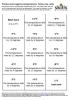
An Australian version (i.e. uses A$, Australian vocabulary and minimum wage details, etc.) of the popular Stash the Cash written by Andy Morrell in 2010. In addition to currency changes this version also includes an extra version of the calculations table and other changes. For example,  the table on page 3 has extra columns to make the mathematical operations explicit and to allow students to practise writing mathematical “sentences”.

Level
Entry Level 3
Level 1
Level 2
Maths
FM E3.8 Read, write & use decimals up to two decimal places
FM L1.2 Recognise and use positive and negative numbers
FM L1.11 Add, subtract, multiply & divide decimals up to 2 decimal places
FM L2.1 Read, write, order & compare positive & negative numbers of any size
FM E3.10 Calculate with money using decimal notation & express money correctly in writing in pounds and pence
FM E3.21 Extract information from lists, tables, diagrams, charts; create frequency tables
FM E3.23 Organise & represent information in appropriate ways inc. tables, diagrams, simple line graphs & bar charts
FM L1.29 Find the mean & range of a set of quantities
FM L2.23 Calculate the median & mode of a set of quantities

Context
Business & Money management
Independent living

A game of language feature bingo, with answers, for L1 and L2 learners.

Editor's notes

I love this! A simple idea perfectly executed (and easily adapted or added to).
Note that although this is a PPT resource you do not need PPT to use it in the classroom.

Level
Level 1
Level 2
English
FE L1.12 Recognise that language & other textual features can be varied to suit different audiences & purposes
FE L2.14 Understand how textual features/devices can shape meaning for different audiences/purposes
FE L1.24 Use format, structure & language appropriate for audience & purpose
FE L2.27 Use language & register (e.g. persuasive techniques, supporting evidence, specialist words) to suit audience & purpose

A hangman style game created in Google Jamboard (a free animated whiteboard app). Based on a game I used to play on a traditional whiteboard with a cut-out crocodile and person (held in place with blu-tac!) and river created with a blue whiteboard marker. When Covid-19 and remote teaching came along, I needed something else.

You can access the jamboard here

Level
Entry Level 1
Entry Level 2
Entry Level 3
English
FE E1.15 Spell correctly words designated for Entry Level 1
FE E2.16 Spell correctly words designated for Entry Level 2
FE E3.17 Spell correctly words designated for Entry Level 3
ESOL
ESOL Writing: word focus - spelling and handwriting (Ww)

Entry Level 1 phonics cleverly disguised as a board game for 2-4 players. Based on Annie Hammersley's Dolch Words board game (still available, refer to ' See Also' for link) of 2009.

Choice of 5 boards that cover Dolch words, - aw- words and  -i-e (long 'I' silent e words).  Fully mapped to the revised Functional English content (2019) - with a complete list of E1 reading and spelling expectations. Extension activities also include spelling.

Editor's note

Level
Entry Level 1
English
FE E1.8 Read correctly words designated for Entry Level 1

A game for 2 players to help with multiplying decimals with or without a calculator.
Learners take turns to choose 2 numbers to multiply, then cover up the answer on the grid. This continues until a player has 4 counters/initials in a row(diagonally, horizontally or vertically).
Prompts can be used for learners to pick a target answer and to try to work out which 2 decimals are going to give that answer.
Editor’s note
Laminate for re-use. A great game.

Level
Level 2
Level 1
Maths
N2/L2.6
AN N2/L1.5 Calculate with decimals up to 2dp
Functional Maths - numbers and the number system

A simple but effective dice game to help students become familiar with, and practise, calculating percentages of amounts. You will need to customise 2 dice by writing amounts on one and percentages on the other.
I usually play this game with low ability students after teaching them a fail-safe calculator method for working out percentages of amounts, but it can be adapted for higher level learners.
It also helps to reinforce that 0% of a number is nothing and 100% of a number is all of it.

Level
Level 2
Level 1
Entry Level 3
Maths
AN N2/L2.8 Find percentage parts of quantities and measurements
Functional Maths - numbers and the number system
AN N2/L1.9 Find simple percentage parts of quantities and measurements
N2/L1.8