ESOL Ws/E2.4a Use a capital letter for proper nouns

Use a capital letter for proper nouns (i) Understand when capital letters are used, e.g. for days, months, names of people and places, and apply this in writing

A short story about a family day out.  The family go pond-dipping.  Easy to read with two lovely images to spark discussion and interest.  Worksheet to be given after reading the text. The second part of the worksheet should be completed without the text (if possible). Entry 1 to E2.  Some support may be needed at E1. Also a more complex / longer version for Entry 3 to lower L1.

Editor's notes

Level
Entry Level 1
Entry Level 2
Entry Level 3
Level 1
English
FE E1.10 Understand a short piece of text on a simple subject
FE E2.8 Understand the main points in texts
FE E3.9 Identify, understand & extract main points & ideas in/from texts
FE L1.9 Identify & understand the main points, ideas & details
FE E2.13 Use basic punctuation correctly (e.g. full stops, question, exclamation marks)
FE E1.13 Use lower-case letters when there is no reason to use capital letters
FE L1.19 Use a range of punctuation correctly (e.g. full stops, question marks, exclamation marks, commas, possessive apostrophes)
ESOL
ESOL Rt/E1.1a Follow a short narrative on a familiar topic or experience
ESOL Rt/E1.1b Obtain information from texts
ESOL Rt/E2.1a Use a range of strategies to trace & understand main events
ESOL Ws/E2.4a Use a capital letter for proper nouns
ESOL Ws/E1.1a Construct a simple sentence, using basic word order & verb form
ESOL Ws/E2.3a Use correct punctuation, e.g. capital letters, full stops, question marks
ESOL Writing: word focus - spelling and handwriting (Ww)
ESOL Rt/E3.1a Understand how meaning is built up in a variety texts of more than one paragraph
ESOL Rt/L1.1a Understand how meaning is built up in paragraphed texts
ESOL Rs/L1.2a Use punctuation to help understanding
Context
Science, Nature & Weather

A proper noun is a special name for a person, place, or thing. It always starts with a big letter (capital letter). Proper nouns tell us the exact name of something.

Editor's notes

Short, straightforward and very useful for underpinning and/or revision. A short introduction followed by 4 graduated reading and writing tasks.

Level
Entry Level 1
Entry Level 2
English
FE E1.11 Punctuate simple sentences with capital letter & full stop
FE E1.12 Use capital letter for pronoun ‘I’ and proper nouns
FE E1.13 Use lower-case letters when there is no reason to use capital letters
FE E2.13 Use basic punctuation correctly (e.g. full stops, question, exclamation marks)
ESOL
ESOL Rs/E1.1b Use full stops and capitalisation to aid understanding
ESOL Rs/E2.1d Use punctuation and capitalisation to aid understanding
ESOL Rs/E3.2a Recognise function of CLs, full stops, commas, question- exclamation- and speech marks, bullet points /numbering
ESOL Ws/E1.2a Use basic punctuation to show where sentences begin and end
ESOL Ws/E2.4a Use a capital letter for proper nouns

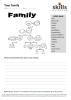
Use the family tree to help write simple and compound sentences about your family. Written for E1-2 ESOL  but also suitable for E1-2 Functional English.

Editor's notes

A lovely way to reinforce sentence structure and basic punctuation, and (for ESOL) teach key family words such as cousin, grandmother, nephew, etc. Worksheet with detailed mapping and sample answers available in a  separate document.

Level
Entry Level 1
Entry Level 2
English
FE E1.11 Punctuate simple sentences with capital letter & full stop
FE E1.12 Use capital letter for pronoun ‘I’ and proper nouns
FE E1.13 Use lower-case letters when there is no reason to use capital letters
FE E2.13 Use basic punctuation correctly (e.g. full stops, question, exclamation marks)
FE 1.16 Communicate information in words, phrases & simple sentences
FE E2.17 Communicate information using words & phrases appropriate to audience & purpose
FE E2.19 Write in compound sentences, using common conjunctions to connect clauses
ESOL
ESOL Ws/E1.1a Construct a simple sentence, using basic word order & verb form
ESOL Ws/E1.2a Use basic punctuation to show where sentences begin and end
ESOL Ws/E1.3a Use basic punctuation to write about oneself using "I"
ESOL Ws/E2.1a Construct simple and compound sentences
ESOL Ws/E2.3a Use correct punctuation, e.g. capital letters, full stops, question marks
ESOL Ws/E2.4a Use a capital letter for proper nouns

Context
Family and relationships

Two one-page tasks covering: punctuation (full stops and capital letters) and writing with simple verb tenses. Use as evidence that a given learning outcome has been achieved. Also useful for diagnostic assessment.

Level
Entry Level 2
ESOL
ESOL Ws/E2.1a Construct simple and compound sentences
ESOL Ws/E2.3a Use correct punctuation, e.g. capital letters, full stops, question marks
ESOL Ws/E2.4a Use a capital letter for proper nouns